
A Primal Dawn
The Death of the Tribe

This is the prologue from Ron’s new book, Primal Dawn. More information about the book and other titles is available at the end of this article.
Twilight Gear Checks
There’s a brutality in waiting for chaos.
You feel it in the weight of the gear, in the muted clicks of rifles being checked in the dark, in the habit of looking over and finding the same eyes already awake, already moving, already carrying their share without discussion.
The air is cold for a little while.
Dust hangs low.
Nobody talks much.
There is always some final adjustment to make, some strap to tighten, some small ritual that steadies the hands before movement. I remember those hours with a clarity that has outlasted almost everything else. Habitual eyes scan your teammates to offer a helpful hand.
That was where I first felt the force of tribe in my marrow.
The Marine Corps gave me a form of belonging that modern civilian life rarely offers. It was stern, imperfect, often brutal in its demands, and yet it was real. A man’s place inside it depended on what he would carry, what he would endure, what he would do when someone next to him was tired, afraid, angry, hurt, or close to breaking.
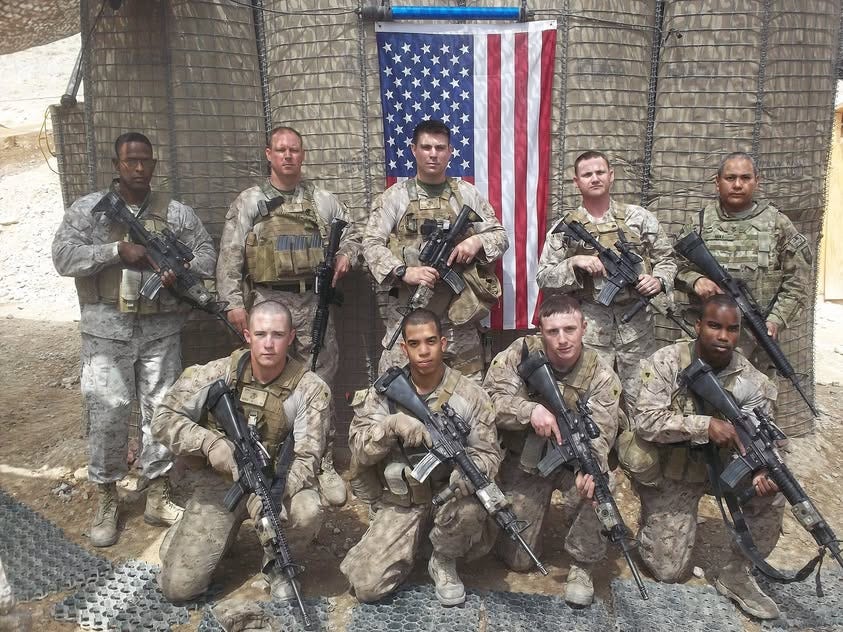
Obligation ran ahead of preference.
Duty was the texture of the day. It lived in the expectation that you would move when movement was required, hold when holding was required, and give up comfort without needing to be persuaded that sacrifice created a net benefit.
Afghanistan clarified that truth because war strips away decorative language. The men beside me were not abstractions. They were not demographic categories, market actors, data sets, or voters to be activated every few years and then forgotten. They were my people in the oldest sense of the term: the ones whose safety touched my own, whose fear entered my body, whose losses would become part of my interior life whether I wanted them there or not. In that world, belonging had weight. It had cost. It had consequence.
Then, when you leave—it’s ripped away. I have spent years since then trying to understand why that experience stayed with me so powerfully, and why civilian life so often felt like a descent from something thick into something thin.
In the meantime, my brothers and sisters in arms have ripped themselves apart on this journey and never found an answer.
For me, the answer took a long time to come into focus.
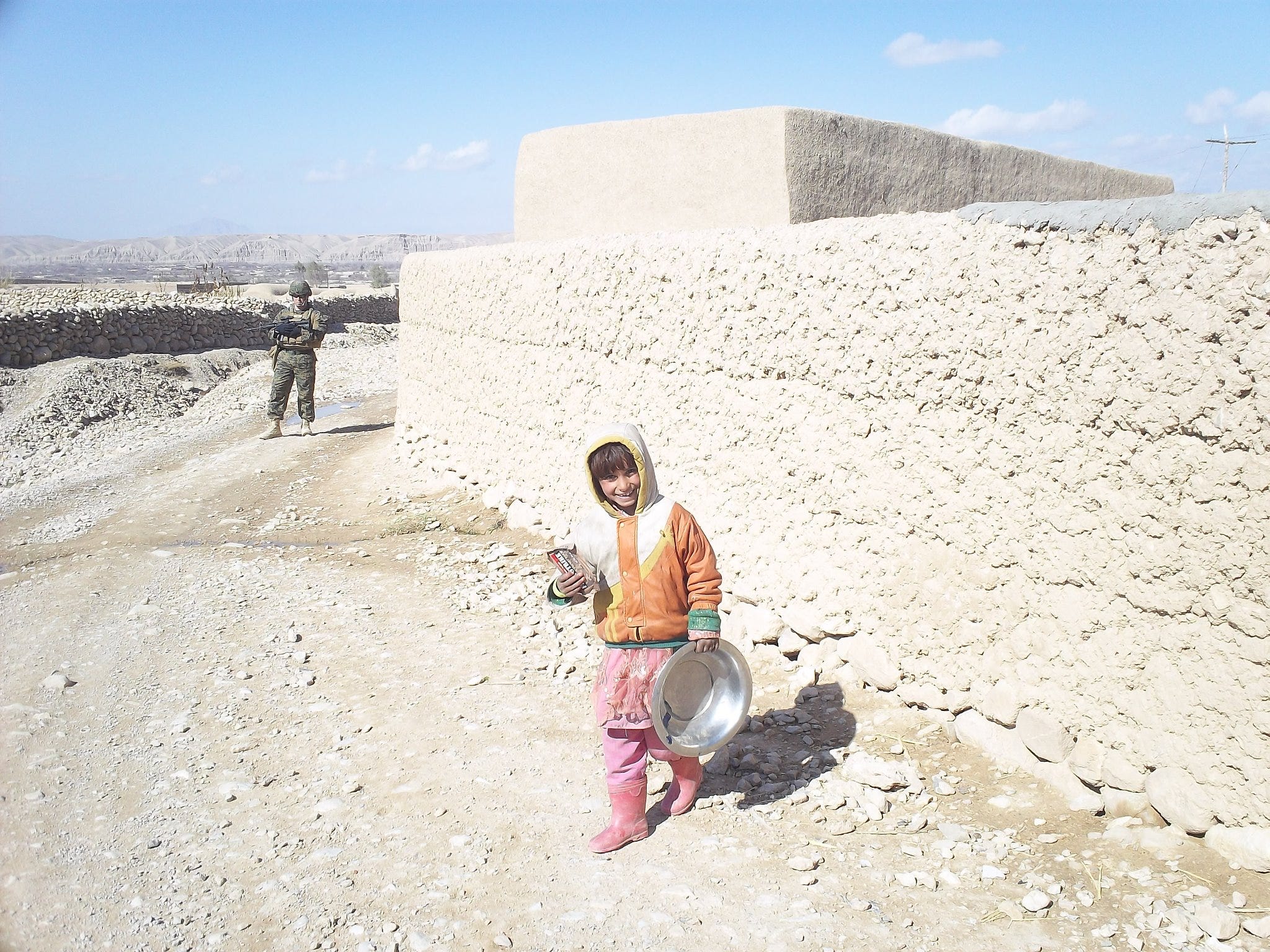
The Afghans were tribal people too. They held tribal bonds that had no use for Prime Minister Hamid Karzai or the Afghan government. They cared about their families and villages. They cared about their crops and their children. They were tired of foreign invaders pilfering their land every thirty years.
Our tribe was there to rip apart their tribe and replace it with democracy. And, at the time, I thought this was right.
I fear I will never be able to atone for my participation in this awful period of our history. Perhaps this book is a start.
What I felt in the Corps was one of the last surviving forms of tribe inside modern America. I felt it then again fourteen years later during a fever dream on a mattress in a maloca.
The Marines had hierarchy, ritual, initiation, discipline, shame, honor, shared symbols, a chain of obligation, and a moral demand that the self answer to something larger. It could be misused. It could be distorted. Every powerful human structure can be. Even so, it revealed a truth that our broader order has spent generations trying to forget: human beings become durable when they are bound to one another in ways that cannot be reduced to transaction.
That realization followed me into the law.
The Calibrated Performances of Concern
In the years after the Marine Corps, I entered courtrooms, offices, hearings, and the dry procedural worlds where power now prefers to speak in the language of neutrality.
I watched the state at work from within its own grammar. I saw the filings, the negotiations, the calibrated performances of concern, the way human beings were translated into case numbers, liabilities, regulated entities, and manageable problems. I watched lives pass through institutions that claimed to exist for justice while often functioning first as systems of preservation—preservation of authority, preservation of process, preservation of the machine’s right to go on being—the machine.
What unsettled me was not simply that government had become large.
Empires have been large before. Kingdoms have always wanted reach. What unsettled me was the direction of service. We still recite the old formula that government serves the people.
In practice, the people increasingly serve government—its appetites, its wars, its procedures, its narratives, its need to perpetuate itself. Our governing order has drifted so far from the tribe that it no longer asks, at any serious level, what kind of life would make a people coherent, healthy, honorable, and hard to break. It asks how to maintain compliance, extract revenue, contain disorder, and preserve legitimacy long enough to continue.
That reversal is one of the central facts of modern life. The state presents itself as custodian while behaving more and more like a self-protecting organism. It expands its language into every corner of life. It classifies, licenses, monitors, disciplines, and punishes. It speaks constantly of rights while surrounding the citizen with systems that are difficult to refuse and harder still to escape. When a person bends, the machine calls that order. When a person resists, the machine reaches for its familiar instruments—investigation, prosecution, conviction, fine, professional exclusion, administrative exhaustion, public shame. Force still exists at the center, as it always has.
Modernity has simply learned to wrap force in paperwork, moral rhetoric, and managerial calm.
I do not say this as someone who stood outside the structure and guessed at its nature. I say it as someone who walked through parts of it and watched how rarely its deepest concern was the flourishing of the people it claimed to represent.
During my research for this book, I found that a healthy tribe disciplines for the sake of continuity, memory, and shared life. A decayed state disciplines for its own preservation. The tribe still remembers why power exists; the state applies it because—well—that’s just what it does to remain powerful.
Capitalism intensified this rupture until it became the atmosphere of the age.
The market economy entered the older human structures and thinned them from within. It taught men and women to treat mobility as freedom, detachment as sophistication, self-interest as realism, and place-bound obligation as a burden fit for less advanced people. It pulled labor away from kin and turned it into wage dependence. It pulled care away from household and neighborhood and turned it into service provision. It pulled value away from memory, ritual, and honor and translated it into price. Under that pressure, the old bonds weakened. The village lost ground. The extended family narrowed. Ritual became optional, then quaint, then faintly embarrassing. Sacred things were priced, branded, packaged, and sold back in therapeutic fragments.
Once that happened, the state had very little left to negotiate with except isolated individuals and aggregations of anxious consumers.
This is one of the great deceptions of Western political life. We are taught to think of capitalism and democracy as companions, as though markets make citizens stronger and representative institutions make power answerable. What I have seen suggests a darker sequence.
Capitalism dissolves the thick intermediate structures that once stood between person and state. It breaks the local bonds that made people harder to manage from above. It rewards abstraction, mobility, and dependence on impersonal systems. The state inherits the resulting fragmentation and grows larger in response, presenting itself as the only structure still capable of coordination. Capital and government, once described as tools, harden together into a leviathan.
Manufacturing Consent
And a leviathan of that kind does not require deep consent.
The old political promise was simple enough to understand: legitimacy rises from the consent of the governed.
The modern administrative state has learned how little consent it actually needs when it can simply manufacture consent. It can continue through process. It can continue through inertia. It can continue through professional classes trained to mistake management for wisdom. It can continue because most people are too atomized to resist collectively and too dependent on the system to step outside it alone. The citizen becomes legible before he becomes free. He becomes governable before he becomes represented.
That is why so many people feel a pressure they struggle to describe. They sense that they are being ruled by structures that do not love them, do not know them, do not emerge from their neighborhoods, and do not answer to their griefs. They sense that the old contract has been severed. They know, often without saying so aloud, that refusal carries penalties. Bend your will and you survive in tolerable discomfort. Push too hard against the categories imposed on you and the machine marks you with a burn.
It can take your time.
It can take your money.
It can take your standing.
It can take your reputation.
It can take your freedom.
Even where formal punishment never arrives, shame does the work. Social fear does the work. Institutional dependency does the work. “Me too” does the work.
And yet the human need for tribe never disappears. It goes looking for substitutes.
The two-party system is the most efficient instrument of containment ever devised.
It gives a lonely and fragmented people the emotional appearance of belonging while keeping real power at a safe distance. You are told to enter public life through one of two approved doors.
Red tribe or blue tribe.
Union or management.
Pro-life or abortion.
Red pill or blue pill.
Choose your banner.
Choose your enemies.
Choose the package of moral reflexes, policy instincts, cultural signals, approved fears, and sanctioned hatreds that comes with your side. Once you enter, the sorting begins. Facts are filtered through allegiance.
Dissent becomes betrayal.
Independent judgment becomes socially expensive.
A citizen who might have become part of a real local tribe—a people bound by work, place, memory, shared sacrifice, and mutual aid—is converted instead into partisan energy unable to bind along any other line.
The party system feels so emotionally intense and so spiritually empty at the same time. It mimics the heat of tribe while withholding the substance. It gives us slogans in place of kinship, outrage in place of ritual, platform planks in place of mutual obligation, digital signaling in place of embodied loyalty. It recruits the tribal impulse and redirects it upward into institutions that do not intend to surrender control. Our need for belonging is harvested, organized, monetized, and then fed back into a state that grows more insulated with each cycle.
The republic still survives as a word.
Democracy still survives as a ritual.
We perform our recurring acts of civic devotion.
We vote.
We posture.
We announce that sovereignty resides in the people.
Then the broader machinery goes on operating through bureaucracy, finance, media, professional management, and the permanent interests that outlast every election. The ordinary person is invited to participate at the surface and disciplined at depth. The forms remain visible. The substance has thinned almost beyond recognition.
That is why I keep returning, in memory, to the men and women I served beside and to the feeling I knew there. The Corps did not give me a theory. It gave me a standard. It showed me that people can still be formed into something more serious than a collection of preferences. It showed me that obligation can still outrank appetite. It showed me that fraternity becomes strongest when it is tied to danger, repetition, discipline, and shared purpose.
Later, when I began to study the deeper history of human societies, I recognized those same principles in older forms: longhouses, council houses, camp circles, made relatives, reciprocal labor, ritual calendars, elders, mothers, sacred obligations to land, systems of belonging that widened the self by binding it.
Even street gangs exhibit the same characteristics. Any people that reject society form tribal bonds.
Those worlds are never perfect.
Human beings never are. They had conflict, hierarchy, error, and pain. Even so, they understood something that our civilization has spent centuries dismantling. A people remains human when life is organized around duties that precede the market and loyalties that precede the state. The tribe, in that older and harder sense, does not exist to flatter identity. It exists to carry life: to form children, restrain men, honor women, bury the dead, absorb grief, distribute burdens, remember the ancestors, and teach each person that freedom without obligation turns quickly into decay.
We live now among the ruins of those structures.
Capitalism shattered the tribe and called the wreckage progress.
Western governance climbed into the space that opened and called the arrangement freedom. The parties divided the population into counterfeit tribes and called the result self-government. We have spent generations learning how to survive inside this order. We have also spent generations becoming lonely enough, suspicious enough, indebted enough, distracted enough, and obedient enough to forget what was taken from us.
I do not believe that forgetting can last.
Something in us still knows the difference between managed allegiance and real belonging. Something in us still responds to duty, ritual, place, and shared sacrifice when we encounter them. Something in us still wants a form of life in which power answers downward, where law remembers its people, where wealth circulates through obligation, where the dead are not abandoned to private memory and the living are not left to negotiate every bond as if love, loyalty, and care were contract terms.
The next pages begin with that conviction.
The crisis of our time is political, economic, and spiritual.
It is also tribal.
We destroyed the structures that made human beings coherent, and then we handed ourselves over to systems that profit from our dislocation. Now we are invited to live as fragments under a leviathan that speaks in our name while feeding on our weakness. The tribe will return because the need never left. The question hanging over the modern world is what form that return will take: another managed camp organized for power from above, or a human order rebuilt from obligation, memory, reverence, and the fierce local bonds that make a people difficult to own.
About this Article
This article is an excerpt from Ron’s next upcoming book Primal Dawn. Primal Dawn is a work that begins with a feeling most people recognize but cannot locate: something in modern life has thinned, and no amount of comfort seems to replace it.
Ronald W. Chapman II traces that sensation back to a structural rupture. Human life was once organized through kinship, ritual, obligation, and place—systems that made belonging a daily fact rather than a preference. Those systems did not disappear by accident. They were dismantled, first by expanding state power and then more completely by capitalism, which converted obligation into contract, memory into price, and community into a network of exchanges.
What followed was not the end of tribe, but its distortion.
The need for belonging persisted. It reappeared in thinner forms—politics, media, identity—where allegiance intensifies but responsibility does not. People gather, sort, defend, and signal, yet these formations cannot feed, bury, reconcile, or carry one another through hardship.
They feel like tribe. They do not function like one.
Drawing on comparative historical evidence—from kin-based societies structured by reciprocity, ritual, and accountable leadership—Primal Dawn shows that durable communities are built on systems of obligation, shared meaning, and repeated collective life.
Primal Dawn follows the arc of that loss and asks what it would take to rebuild a form of belonging that can hold under pressure—something thicker than allegiance, and harder to replace.
About the author
Ronald W. Chapman II, Esq., LL.M., is an American author and lawyer and former Marine Corps officer who skillfully combines classical training in philosophy, rhetoric, and behavioral economics with contemporary expertise in law and strategy. With a law degree and a Master of Laws (LL.M.) from Loyola University Chicago, Chapman has carved out a distinguished career as a federal criminal defense attorney. His remarkable achievements include nearly two hundred federal counts acquitted in high-stakes cases.
Ron is the host of the acclaimed YouTube show OFF AIR.
Chapman’s unique approach to persuasion stems from his profound understanding of human behavior and his ability to seamlessly integrate timeless principles of logic and rhetoric with cutting-edge communication techniques. His expertise empowers individuals to craft messages that not only resonate but also foster genuine connections in an information-overloaded world.
Drawing on his courtroom triumphs, scholarly background, military experience with the United States Marine Corps, and unwavering passion for effective communication, Chapman offers readers the tools to make their ideas resonate deeply and meaningfully. Whether in the courtroom or through his writing, Chapman is dedicated to guiding others through the complexities of modern persuasion with authenticity and skill.