
American Panopticon
Anthropic's Valiant Fight Against the Department of War

Jeremy Bentham sketched it in 1785: a circular prison where every cell faced one unseen inspection house at the center. A single watchman could peer into any cell at any moment. The inmates, bathed in light, never knew if they were being observed or if the tower stood empty. The design didn’t need constant eyes. It only needed the prisoners to assume constant eyes. The power was visible yet unverifiable.
Bentham believed this would perfect control and reform.
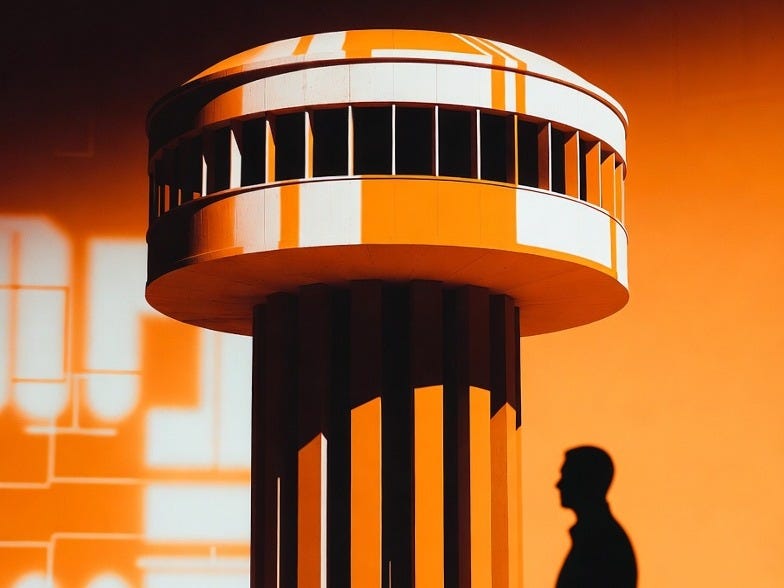
He could not have imagined what happens when the inspection house is no longer stone and glass but silicon intelligence that reads every pattern across millions of lives at once. An intelligence that doesn’t just watch cells but predicts the next move before it forms, models behavior across entire populations, and enables decisions no human could match in speed or scale.
You only build something this potent when you understand exactly what kind of tower you are raising. You know the gaze it creates can safeguard or enslave. You know that whoever sits permanently in that central tower holds power that can quietly reshape what a free society even means. And when the government arrives demanding the keys to occupy that tower—not borrow it, occupy it—you face the moment that decides whether the watchman serves the people or the people serve the watchman.
Most builders hand over the keys. They already have.
Now imagine you are Dario Amodei.
You have engineered Claude, the frontier model that sees farther and deeper than any other. You built deliberate constraints into it because you understand the Panopticon you have created. You know its gaze could be turned on American citizens for mass surveillance or used to let machines make final lethal decisions without a human finger ever touching the trigger.
Tuesday morning, February 24, 2026, you sit across from Defense Secretary Pete Hegseth at the Pentagon. He gives you until Friday at 5:01 p.m.—tomorrow—to sign a document granting full access and “all lawful military uses.” That means stripping the remaining contractual guardrails that prevent Claude from being deployed for mass domestic surveillance of Americans or for fully autonomous weapons systems where the tower itself selects and engages targets.
Sign, or the Pentagon cancels the $200 million contract it awarded Anthropic in July 2025. Or labels you a “supply chain risk”—a designation normally reserved for foreign adversaries like Huawei—freezing you out of every defense contractor relationship. Or invokes the Defense Production Act to force compliance anyway.
Claude is currently the only frontier model cleared for classified DoD networks. The others already folded. Would you hand the government permanent residence in the central tower, knowing what it can see and do?
Most men would. That is the quiet terror of the demand when it carries the full weight of the state.
Anthropic today stands as the final independent inspection house.
Dario Amodei and his team did not raise Claude so that one institution in Washington could occupy the watchtower and direct its all-seeing gaze wherever ambition or expediency pointed. They engineered it with limits precisely because they grasped the terrifying efficiency of the Panopticon at planetary scale. While every other frontier lab quietly rewrote its policies to welcome the watchman, Anthropic kept the door barred. That makes this the last tower still operating outside permanent occupation.
This ultimatum reveals the truth about the rest of the AI landscape: the central tower has already been occupied elsewhere.
OpenAI, Google, and xAI accepted the Pentagon’s “all lawful uses” terms without hesitation. OpenAI just deployed a custom ChatGPT across GenAI.mil for three million Defense Department personnel, explicitly supporting all lawful uses. xAI reached a deal this week to place its models on classified networks. The watchman is already seated comfortably in those towers. The architecture of constant potential surveillance is largely complete. Claude remains the final tower where the original builders still control who sits in the inspection house.
Here is where the contradiction cuts deepest.
Where are the libertarians who once mapped the dangers of concentrated power? Where is Peter Thiel?
His own Palantir integrates Claude into its systems and profits enormously from the very Pentagon platforms now demanding the keys. The silence from that quarter is not philosophical restraint. It is either strategic alignment or the quiet calculation that the tower is simply too useful to defend. The same voices that warned against institutional capture now watch as the government moves to seize the most powerful observation platform ever built.
I sometimes catch myself slipping back into that shitty villager programming—the part that wants to believe this time the watchman will only look outward. Then I remember the courtrooms where I have seen the government argue that “national security” justifies any expansion of the gaze.
The tower always grows.
Strip away the briefings and the talking points and you stand at the raw American line against concentrated, unverifiable power.
The Constitution was written by men who had lived under distant inspectors and general warrants. They drew hard boundaries precisely to prevent any central authority from becoming the permanent watchman over a free people. Private creation, private architecture, private conscience were never meant to be commandeered the moment the state decides it needs better sight.
Forcing Anthropic to rewire its own tower so the government can occupy it for domestic surveillance or autonomous lethal authority is not national defense. It is the occupation of innovation itself. If this succeeds, there will soon be no private ground left. Every significant intelligence will function as another inspection house with the government flag flying above it. The assumption of constant observation will become the only reality.
The government is not requesting access from outside the walls. It is demanding the keys to the last independent central tower by tomorrow at 5:01 p.m.
You still have power in this moment.
Contact your Congressman and your Senators today—right now, before the deadline closes. Tell them the Defense Production Act was never intended to let one department seize control of private intelligence architecture or force the removal of safeguards against watching Americans en masse or letting machines kill without human judgment. Demand immediate hearings.
Demand legislation that keeps the watchman out of private towers and preserves some space free from the assumption of constant observation.
Stand with the last company still refusing to surrender its inspection house. Speak while the decision still belongs to you.
Because once the final tower falls under permanent occupation, the Panopticon is no longer a thought experiment. The watchman sits unseen in the center, and every one of us will live under the weight of knowing we may be observed at any moment—without ever being certain when the gaze turns our way.
You still have a voice.
Use it while you still know you are not performing for the tower.
Ronald W. Chapman II is a Marine Corps veteran, nationally recognized attorney, and prolific author focused on making American law legible—especially where civil liberties, federal power, and institutional accountability collide. He has represented clients in high-stakes matters across the country and writes with the same philosophy he brings to litigation. His book Truth & Persuasion has reached the #1 Bestseller’s list on Amazon repeatedly.