
An Outlawed Feast
An Excerpt from Ron's Upcoming Book "Primal Dawn"

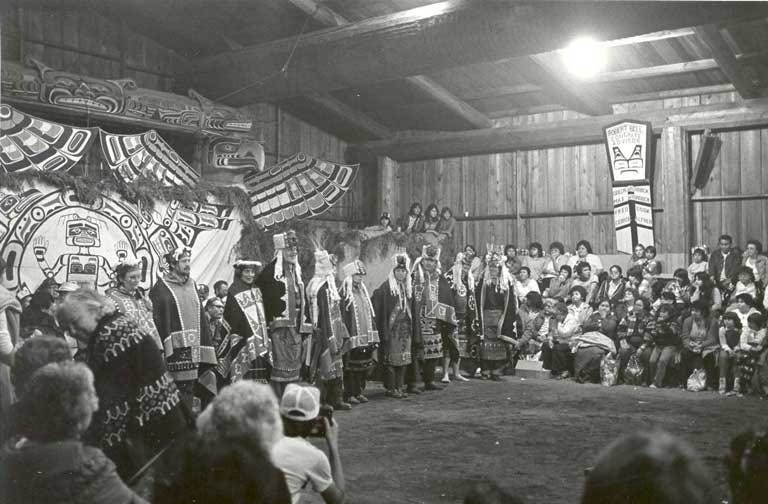
On Christmas Day in 1921, on Village Island off the coast of British Columbia, a Kwakwaka’wakw chief named Dan Cranmer held a potlatch. It was a large one. There were hundreds of guests. There were songs, speeches, gifts, masks, feasting, and the public recognition of names and rights. And because this was Canada in 1921, the whole thing had to be done in secret.
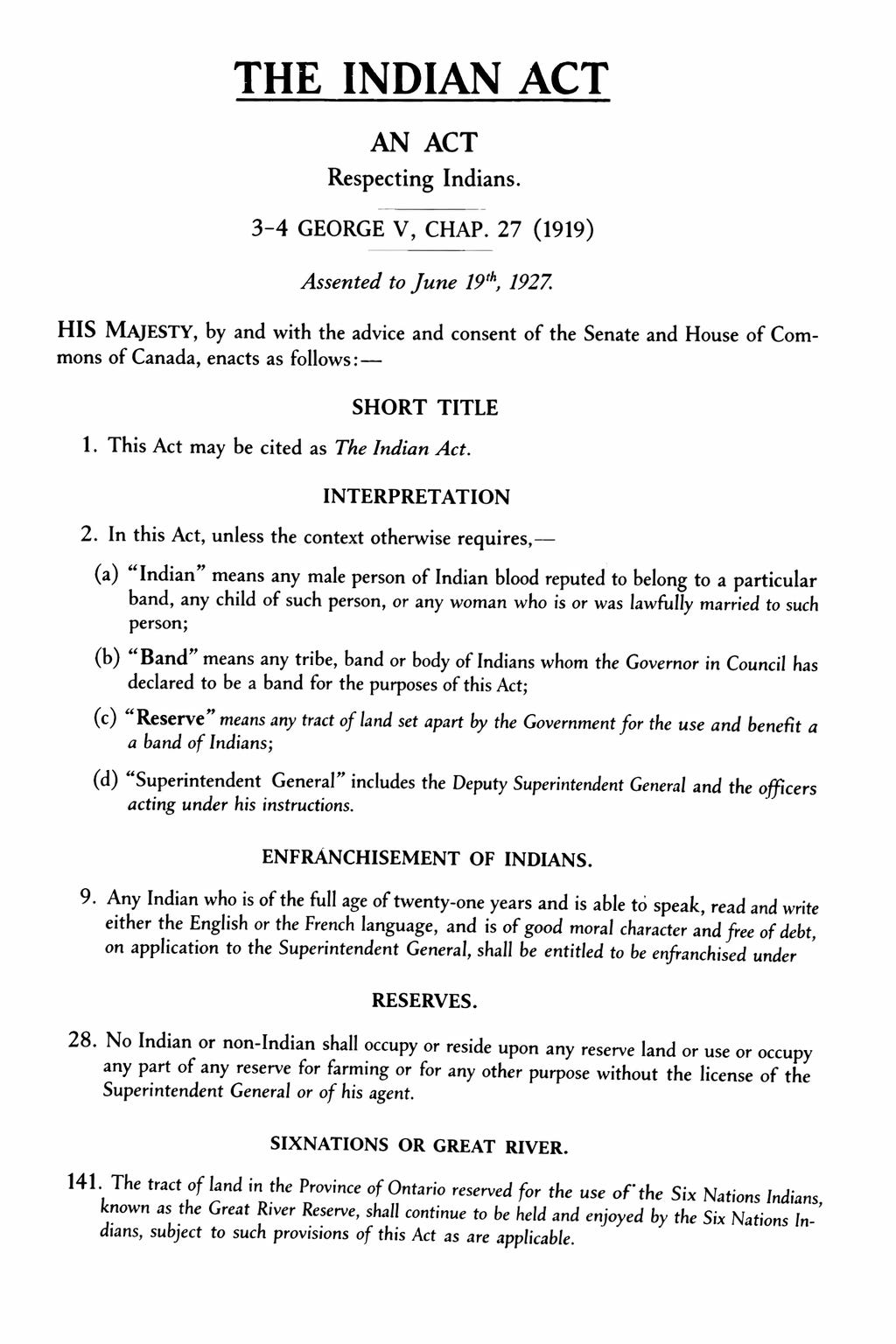
As part of the Indian Act, the state had outlawed potlatching.
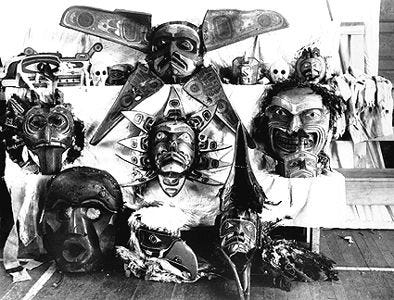
When officials learned what had happened, participants were arrested, prison sentences followed, and ceremonial regalia was confiscated and dispersed into museums.
Why would a modern state be frightened of a feast?
A potlatch is merely a party. It’s a ceremonial distribution of wealth that affirmed status and social order. Rights and titles were publicly acknowledged there. It was the place where history is passed on in songs and dances so it will not change. In other words, the potlatch was part parliament, part archive, part court, part welfare system, part theatre.
But most of all, it was part threat to Western Governance.
It stored memory in long ceremonial lines. And it rested on a principle that market society has always found faintly offensive: wealth of a community exists independent of possessions.
During a Potlatch the ritual tells a group who belongs, who owes, who remembers, who mourns, who speaks, who witnesses, and how abundance is distributed.
A people can lose land, lose official recognition, lose legal standing, and still retain a ritual grammar for turning a crowd into a community.
The Canadian state understood and this is why it abolished the ritual. The state’s goal was to destroy the structure of the society by stopping the ceremonies, the songs, and the history carried through them.
We are used to telling the story the other way around.
First came tribe.
Then came market.
Then came modernity.
Tribal living was a relic for those that failed to adapt to modernity.
Tribe, in that story, is childhood: intimate, local, and doomed to be outgrown. But a surprising number of thinkers keep arriving at a more awkward possibility. Many so-called “tribal” societies were not failed states in waiting. They were societies organized to prevent coercive power from hardening into the state. In parts of Southeast Asia, entire populations moved, adapted, and remained hard to rule in order to avoid slavery, taxation, forced labor, warfare, and disease imposed by surrounding states. What looks primitive from the capital can look, from the hills, like strategy.
Large capitalist systems like legibility.
They like a population that can be named, counted, taxed, settled, mapped, and improved from above. Centrally managed schemes fail when they flatten local interdependencies that cannot be fully seen from the center. Even the origin story of early states becomes less flattering: instead of emerging simply because life improved, they were bound up with domestication, control, and unfair labor. Not every tribal society was idyllic but the state should no longer be treated as history’s obvious reward for growing up.
The state’s distinctive violence lies in trying to pull “the economy” out of social life and let it operate by its own profit logic, treating land, labor, and money as commodities. Before coins and wages, there were webs of credit, favor, promise, kinship, and mutual commitment.
Hard, exact, enforceable debt does not usually arrive alone. It tends to arrive with states, soldiers, police, and the capacity to punish. Put more simply: capitalism did not merely invent new ways of trading. It attacked older ways of belonging. It converted relationships thick with obligation into transactions thin with price.
There is another way to see this. In traditions grounded in reciprocity, gifts do not end with receipt. They begin there. They create responsibilities. Wealth is not proof that you can stand alone. Wealth is proof that you are in good relation. A potlatch turns surplus into trust, rank into obligation, and memory into social insurance. It distributes abundance the way a living ecosystem does—outward, relationally, sustaining the whole.
This same logic appears in unexpected places. In damaged forests, among displaced people, and in fragile economies, life persists not through efficiency but through improvisation and cooperation. Global markets may connect the system, but survival remains local, contingent, and deeply human. What grows in the ruins is not sleek order. It is collaboration among people and environments that no longer fit the clean mythology of the market.
And when the ruin is sudden—after disasters, crises, or collapse—the same pattern emerges. Ordinary people do not become savages. They become neighbors. They cook, ferry, search, improvise, and build networks of care. The panic belongs less to the crowd than to elites, who fear disorder and often obstruct the informal cooperation already saving lives. We are taught to expect catastrophe to reveal selfishness. Again and again, it reveals something closer to solidarity.
That is where the word tribe becomes useful again, though only if handled carefully. Not as blood purity or frozen identity, but as a circle of reciprocal obligation thick enough to outlast institutions. In modern terms, we call it mutual aid. When formal systems lag or fail, people assemble food, childcare, and support through trust-based networks. This is not a relic. It is a recurring human behavior. When the official grid stalls, people make kin faster than bureaucracy can process forms.
Still, there is a trap. Capitalism can colonize tribal language too.
Cultural resurgence can be absorbed into new hierarchies. Identity can be packaged, performed, and sold. The point is not to idealize tribal cultures or pretend every invocation of ancestry is liberating. The point is to distinguish between belonging as a lived structure of reciprocity and belonging as a brand.
This is why the idea of many worlds matters. There is no single system into which all societies must be folded. The alternative to one dominant model is not chaos, but plurality: multiple ways of organizing life that are collaborative, place-based, and interdependent in different ways. The tribal future, if it comes, will not be a reenactment. It will be an experiment—many experiments—in re-embedding life in relationship: new rituals, revived traditions, commons, local infrastructures, and forms of belonging that resist being reduced to price.
Which brings us back to Dan Cranmer’s feast. The government could arrest dancers. It could confiscate masks. It could scatter treasures across distant museums. What it could not do was abolish the social logic those objects served. Many of those objects have since returned. But the deeper truth is that the archive was never only the object. It was the relationship around the object: the songs, the names, the sequence, the witnesses, the meaning.
So perhaps the real sequence is not tribe, then capitalism, then progress.
Perhaps it is this…
human beings begin with interdependence
Capitalism scales by thinning that interdependence, pricing more of life, rewarding hoarding, and teaching us to call dependency weakness. It produces astonishing abundance, but often in a form that burns through land, attention, trust, and memory. And when that system buckles—through dispossession, ecological strain, financial precarity, or sudden disaster—people do something very old.
They gather.
They feed each other.
They make witness.
They recover story.
They build rituals sturdy enough to turn strangers into the kind of people who will come when called.
In that sense, tribes do not emerge from the ruins because history runs backward. They emerge because, under pressure, human beings keep rediscovering the same truth: survival is social, and society needs ceremony.
About the author
Ronald W. Chapman II, Esq., LL.M., is an American author and lawyer who skillfully combines classical training in philosophy, rhetoric, and behavioral economics with contemporary expertise in law and strategy. With a law degree and a Master of Laws (LL.M) from Loyola University Chicago, Chapman has carved out a distinguished career as a federal criminal defense attorney. His remarkable achievements include nearly two hundred federal counts acquitted in high-stakes cases.
Chapman’s unique approach to persuasion stems from his profound understanding of human behavior and his ability to seamlessly integrate timeless principles of logic and rhetoric with cutting-edge communication techniques. His expertise empowers individuals to craft messages that not only resonate but also foster genuine connections in an information-overloaded world.
Drawing on his courtroom triumphs, scholarly background, military experience with the United States Marine Corps, and unwavering passion for effective communication, Chapman offers readers the tools to make their ideas resonate deeply and meaningfully. Whether in the courtroom or through his writing, Chapman is dedicated to guiding others through the complexities of modern persuasion with authenticity and skill.
More about Potlatch
Credit to the Canadian Encyclopedia for its article on the Potlatch Ban
I never knew that but always suspected that. I love American history and have always associated myself (although Irish/Italian) with our Native American brothers as much of their culture is of God, not man. Christianity became a central point of many because Jesus like them, as a man, walked the earth in perfect harmony and order, living as they lived. Giving as they gave. He is a God who walked with man as a man. Living in Oklahoma is like living in real America, where the Federal and local laws obscure, but do not overpower the tribe. We still have Chiefs and the old law written in the hearts of all those who have the ‘tribal’ Spirit within them. Oklahomans may fall prey to political pressure and fear of looting a heritage again by the elite who live by the sword and the shield of lies that give them a false power. The tribe survives.
Enjoyed this read, look forward to the book