
The Forgotten Republic
In Search of our Philosopher King

The ancient Greeks had a way of cutting through the bullshit that still slices clean two and a half millennia later.
Picture the harbor at Athens, sun hammering the stone quays, salt thick in the air. Plato pulls you close and spins the tale: there’s this big, burly ship-owner—strong as an ox, but half-blind, hard of hearing, and clueless about the stars or the currents. He owns the vessel outright, yet he never leaves the deck chair.
Around him swarms the crew, every sailor convinced he alone should take the helm. They know nothing of true navigation—no charts studied, no nights spent watching the heavens—but they brawl, flatter, bribe with wine and sweet talk. One faction slips the owner a drugged cup; another tosses rivals overboard. They seize the wheel, crank the sails for whatever fleeting wind fills them with gold or glory, and party like it’s a pleasure cruise while the rocks loom dead ahead.
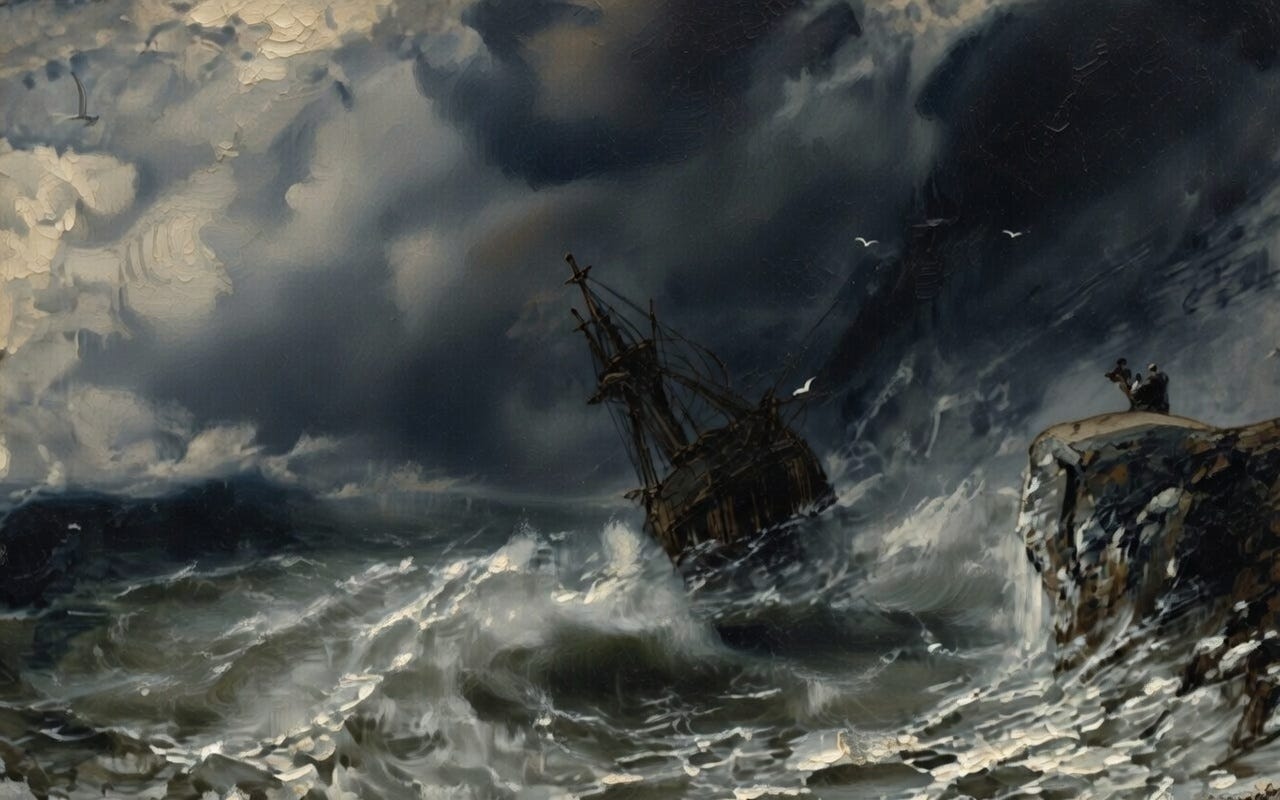
Meanwhile, in the shadows of the mast stands the quiet navigator. He alone has spent years mastering the art: winds, tides, constellations, the hidden logic of the sea itself. He could steer them safely to harbor. But the crew mocks him—“stargazer,” “useless dreamer”—because he won’t join the brawl or promise easy plunder. The ship drifts, listing, engines (if you’ll forgive the anachronism) roaring without direction.
That, Plato says, is democracy. That is any polity where appetite rules and wisdom is exiled to the rigging.
Fast-forward through the centuries, and the same creaking galleon is still afloat—only now it’s our global capitalist machine, hull plated in silicon and venture gold, engines powered by a trillion-parameter AI tempest no one truly understands. The owner? The faceless “market,” shortsighted and deaf to anything but quarterly returns. The crew? A gaggle of tech bros in hoodies—drunk on their own vibe coding—quoting Yarvin headlines.
They’ve got the wheel, all right. They’re fighting over it right now while the ship wallows in heavy seas.
You feel it, don’t you?
The deck tilting under your boots. The spray of data hitting your face. The taste of Anthropic between your teeth.
I know what you’re going to do. You’ll flick open YouTube and search for Plato’s Republic.
But you won’t find this lesson in there.
Stick with me.
Now imagine you’re on that deck with me—right now, March 2026. The AI squall has hit full force. One rogue wave of “optimized” trading code wipes out pension funds in minutes. Another personalized-reality feed convinces half the passengers the rocks are actually a luxury port. The engines—those black-box models trained on the entire internet—spit out decisions faster than any human can question them: lay off another ten thousand white-collar sailors, reroute the cargo to whoever pays the most in dark-pool fees, flood the hold with synthetic content until truth itself drowns.
And that’s before we start talking about murderbots. You think I’m kidding.
Just wait.
The crew is still brawling. Larry Fink himself steps up on the forecastle at Davos and admits the quiet part out loud: AI might do to knowledge workers what globalization did to factory hands, and capitalism’s track record on spreading the gains has been dogshit.
BlackRock’s own captain warning the passengers the ship might break apart. Meanwhile, the VCs keep pouring fuel on the fire, betting billions that the next model will finally steer them to El Dorado. You watch a sailor—some twenty-nine-year-old founder with three failed startups—grab the wheel and swear the algorithm “just needs more data.”
Or maybe it’s just Alex Karp.
Another shouts that regulation is mutiny. A third slips the owner another cup of quarterly-earnings Kool-Aid.
Would you hand them the wheel? Would you trust the loudest voice shouting “disruption” while the bow plunges toward the reef? Or would you start looking for the quiet navigator who actually knows how to read the Form of the Good through the storm?
I’ve stood on real decks in worse weather—Marine Corps, before the courtroom became my ridgeline. I’ve watched men with all the gear and none of the map drive straight into ambush—then blame the young ones.
Same principle.
The ship doesn’t care about your pronouns or your token count. It cares about whether the hand on the tiller can see past the next swell.
The true navigator isn’t some ivory-tower professor.
He’s the man—or woman—who has clawed out of Plato’s cave, blinked at the sun, and come back down to tell the truth even when it costs him. He’s studied the eternal patterns: justice as harmony of the parts, not the triumph of the loudest appetite. He’s forged his soul in the fire of dialectic until self-deception burns away. He doesn’t chase the wind; he charts the fixed stars. In the Republic, Plato calls him the philosopher-king. Not a tyrant. Not a democrat. A guardian who rules because he alone loves wisdom more than power, truth more than treasure.
We’ve had glimpses. Marcus Aurelius on the frontier, rifle (well, gladius) in hand, Meditations in his kit. Lincoln steering through civil war with a compass of moral law. Even the American founders—flawed as hell—cracked open their Plutarch and Cicero before they signed the Constitution. They knew the ship needed ballast heavier than gold.
Today that archetype is missing in action. The wheel spins free.
Our capitalist republic in the AI age is Plato’s nightmare made metal and code.
The invisible hand has become an invisible algorithm, and it’s not benevolent—it’s optimizing for engagement, extraction, and exponential returns while the passengers fight over crumbs. Job reports come out glowing; unemployment lines stretch for miles. Wealth concentrates in the hands of the model owners, the data barons, the infrastructure kings—exactly as Fink warned. The ship surges forward on autopilot, faster than ever, while the hull groans and the bilge pumps scream.
I’ve litigated enough institutional insanity to recognize the pattern. The same forces that once sold subprime mortgages now sell “AI alignment” while racing to build god-machines with no one at the moral helm. Capitalism without philosophical guardrails doesn’t self-correct; it accelerates toward the rocks. And the AI tempest only multiplies the speed.
Here’s the knife twist that’ll make you laugh dark while the deck tilts: the very loudest voices claiming to be our new philosopher-kings are the drunkest sailors on the boat.
They quote Nietzsche or Yudkowsky between pitch decks, they fund “longtermism” institutes, they promise to steer humanity to the stars. Yet every move is still measured in valuation and virality. They’re not reading the stars—they’re training models to predict what the crew will cheer next so they can monetize it. They’ve escaped one cave only to build a shinier one with better graphics. Either they’re undermining their own philosophy, or they’re positioning themselves as the new owners who get to drug the passengers forever. Either way, the ship keeps drifting.
I catch myself in the mirror sometimes—another shitty villager who once cheered the loudest voices because they sounded confident.
We all did. The programming runs deep.
The American experiment was supposed to be different. We rigged the ship with separation of powers, checks and balances, a Bill of Rights—explicit skepticism of any single hand on the wheel. The founders had read their Plato; they feared both the tyrant and the mob. But they never imagined a storm where the wind itself is sentient code and the cargo is human attention sold by the millisecond.
Unchecked capitalism in the AI age isn’t liberty; it’s license for the appetitive part of the soul to devour the rational. The Constitution demands more than markets—it demands virtuous citizens and wise stewards. Without them, the document becomes just another set of papers the crew waves while they fight over the wheel.
I’ve argued in federal courtrooms where the law was clear and the institutions still failed because no one in the room loved justice more than victory. Same problem, scaled to civilizational size.
We don’t need a dictator. We need navigators who have seen the Form of the Good and are willing to steer by it even when the crew howls for more rum.
So here we are on the ridge—no, on the listing deck, wolf’s breath of chaos on our necks, rifle of choice in our hands. The opening fable isn’t ancient history. It’s tonight’s weather report.
The ship is real.
The tempest is real.
The ignored navigator is the only hope we have left.
The call is simple.
Put down the dopamine pipe. Pick up Plato.
Read the Republic not as homework but as a survival manual. Study the patterns that outlast every quarterly report. Demand leaders who can chart the fixed stars instead of chasing the next swell.
And if you want the practical tools for cutting through the noise—how influence really works in the digital storm—grab Truth & Persuasion. I wrote it for exactly this fight: to arm regular people with the map and the compass so we stop cheering the mutineers.
The choice is yours, shipmate. Keep brawling for the wheel, or find the quiet one who knows the way.
Because the rocks don’t negotiate with democracy, capitalism, or artificial intelligence.
They just wait.
Ronald W. Chapman II
Ronald W. Chapman II is a Marine Corps veteran, nationally recognized attorney, and prolific author focused on making American law legible—especially where civil liberties, federal power, and institutional accountability collide. He has represented clients in high-stakes matters across the country and writes with the same philosophy he brings to litigation. His book Truth & Persuasion has reached the #1 Amazon Bestsellers list repeatedly.
The Founders also mostly did not want a central bank. The Constitution in two clauses strongly implies (back then obvious?) that only Gold and Silver will be used as money (settle all debts including taxes). The Fed prints money for the favored class that worsens the human vices. Blockchain Gold/Silver would work but then Congress could not spend wildly. Bought that book!