
The Pin Factory
No you are not going to lose your job...

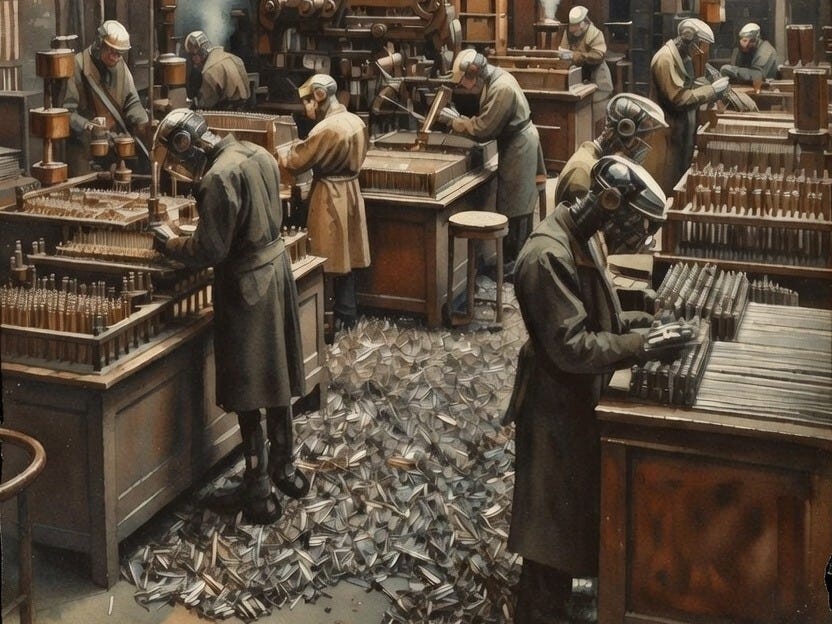
There was a little pin factory in Kirkcaldy, Scotland, 1776.
One lone laborer, no education, no machines, hunched over a bench. He draws the wire, cuts it, points it, heads it, and packages it—all by himself. At the end of a long day he’s lucky to have twenty pins.
Now put ten men on that same floor.
One draws the wire. One cuts. One points. One heads. One packages. Suddenly the same floor spits out forty-eight thousand pins a day.
That’s the fable Adam Smith handed the world. Ordinary men chasing their own interest, each doing one tiny thing perfectly, and the whole economy lifting on the back of that simple split.
We read it in school, nodded, and forgot. We read it from the comfort of a society that no longer relied on child labor. Comfort has an awkward way of requiring that we forget.
My office sits just steps from the Piquette Plant—one of Henry Ford’s earliest factories. I defend my clients from a neighboring building that once housed the machines that powered Detroit. When American industry shipped its labor overseas, the building went quiet. Back then people screamed about the loss of jobs. They’re still screaming about jobs today, even as other American cities move forward and embrace change.
In crept soft socialism and clientelism, a salve to heal their wounds. Detroit continued to crumble.
Adam Smith never forgot the Pin Factory.
He smelled the oil, heard the hammers, watched the output explode, and realized the Invisible Hand was right there—guiding self-interest into abundance without anyone directing it from above. One man’s toil became a nation’s wealth. That was the lesson.
And brothers and sisters, we are living the next chapter of that same fable right now.
The factory never closed. It just got bigger. The workers got smaller. And the line is running faster than any human eye can follow.
Now imagine you’re standing on that same floor today—March 2026. The clanging is gone. The sweat is gone. In its place: millions of AI agents, each one a perfect specialist. One agent draws the economic “wire”—scraping data, cleaning it, structuring it. Another cuts it into forecasts. Another points it into pricing. Another heads it into personalized ads. Another packages it and delivers it to your phone before you even know you need it. No breaks. No fatigue. No unions. Output?
Not forty-eight thousand pins. Trillions of micro-tasks a second. The same floor that once fed a village now feeds the planet. The Invisible Hand never left. It just hired better help.
Would you slow that line? Would you step in with regulations, taxes, or “ethical frameworks” and tell the agents they can only work eight hours, or only in approved languages, or only if a human signs off? Or would you step back, let the division of labor run wild, and watch prices crash while abundance floods every corner of the world? Smith is standing right beside you on the floor, arms crossed, waiting for your answer.
Adam Smith—the quiet Scottish moral philosopher who walked those early factories, notebook in hand, pipe smoke trailing him—became the archetype of the man who saw the machine clearly. A man who understood that real wealth doesn’t come from kings or committees. It comes from letting ordinary self-interest do its gritty work on the factory floor. He watched the pin makers, talked to the butchers and bakers, and realized the dinner on your table arrives not because anyone loves you, but because someone loves profit. That single insight rewrote the world.
Smith would look at today’s AI agents and smile the slow smile of a man proven right. This is division of labor on steroids—the pin factory gone nuclear. Every agent specializes in one microscopic task and does it better than any human ever could. One negotiates your insurance. Another manages your investments. Another writes your code. Another persuades your customers. Another even argues your case in small-claims court.
They don’t unionize.
They don’t sleep.
They don’t need health insurance.
And because each one chases its programmed self-interest—maximize speed, minimize cost, maximize output—the Invisible Hand turns all that silicon greed into human plenty. Prices fall. Quality rises. The poor get richer faster than any government program ever managed.
As I laid out in Truth & Persuasion, this new floor changes everything about how we communicate and influence. Agents don’t just do work—they persuade, negotiate, and frame reality at scale. The book cuts through the hyperreal fog and gives you the exact tools to stay human while the machines handle the heavy lifting. Grab a copy. It’ll be the best investment you make before the next shift starts.
Either Smith would cheer this explosion of specialized agents as the greatest wealth creator since the steam engine, or we’re about to watch the new mercantilists—big tech cartels and anxious regulators—grab the controls and choke the line. Pick one. The same voices screaming about “AI safety” and “job protection” are the modern equivalent of the guilds that tried to keep pin-making a closed shop in Smith’s day. They want to license every agent, tax every transaction, and force “human oversight” on a floor that no longer needs it. Smith would call it what it is: the old fear of abundance dressed up as compassion. The hand that once fed us is now being fitted with handcuffs.
When the first agent swarm hit the market, I wanted the safety rails. I wanted the human touch. Then I watched prices drop on everything from legal work to medical diagnostics and realized I was the one standing in the way of the very abundance Smith predicted.
Strip it down to the bone and this is pure American skepticism of concentrated power—the same fire that wrote the Constitution.
The Founders read Smith.
They knew that when any hand—government, guild, or corporation—tries to direct the factory from above, the line slows, the output drops, and the people pay. Same game on the AI floor. When Washington starts licensing agents or Brussels starts “aligning” them, remember: the Constitution never granted anyone the divine right to slow the pin factory just to protect yesterday’s jobs.
So the next time you see a headline about “AI taking jobs” or “we need guardrails,” remember the floor. The hammers are silent now, but the output is roaring. The Invisible Hand never needed our permission.
It only needed us to step aside.
Ronald W. Chapman II
Ronald W. Chapman II is a Marine Corps veteran, nationally recognized attorney, and prolific author focused on making American law legible—especially where civil liberties, federal power, and institutional accountability collide. He has represented clients in high-stakes matters across the country and writes with the same philosophy he brings to litigation. His book Truth & Persuasion has reached the #1 Bestseller’s list on Amazon repeatedly.